


Where BMI Came From — and What It Was Built to Measure


On this page
If a doctor’s office has ever handed you a BMI number and a category label, it’s fair to ask where that number actually comes from. The answer surprises most people. The formula is almost 200 years old, and it was never designed to tell an individual whether they are healthy.
It was created in 1832 by a Belgian mathematician who wanted to describe groups of people, not examine one of them. More than a century later, an American researcher gave it the name we use now — and even then it was presented as a tool for studying populations, not for diagnosing the person in the exam room.
None of that makes BMI useless. It makes it a specific tool with a specific job. Knowing the job helps you read your own number for what it is: a rough ratio, not a verdict.
Who invented BMI?
Adolphe Quetelet (1796–1874) was a Belgian astronomer, mathematician, and statistician. He was not a doctor, and he was not studying obesity.
What fascinated him was applying probability and statistics to human traits — height, weight, birth rates, even crime rates — to find the patterns that show up across large groups. Working with population data (much of it drawn from soldiers, all of them men), he observed that after childhood, adult body weight tends to rise roughly in proportion to height squared. He turned that observation into a simple ratio: weight in kilograms divided by height in meters, squared.
For the next hundred-plus years, that ratio was known as the Quetelet Index. Most histories date the work to 1832; his major treatise on the subject, Sur l’homme, followed in 1835.
What was BMI originally designed to do?
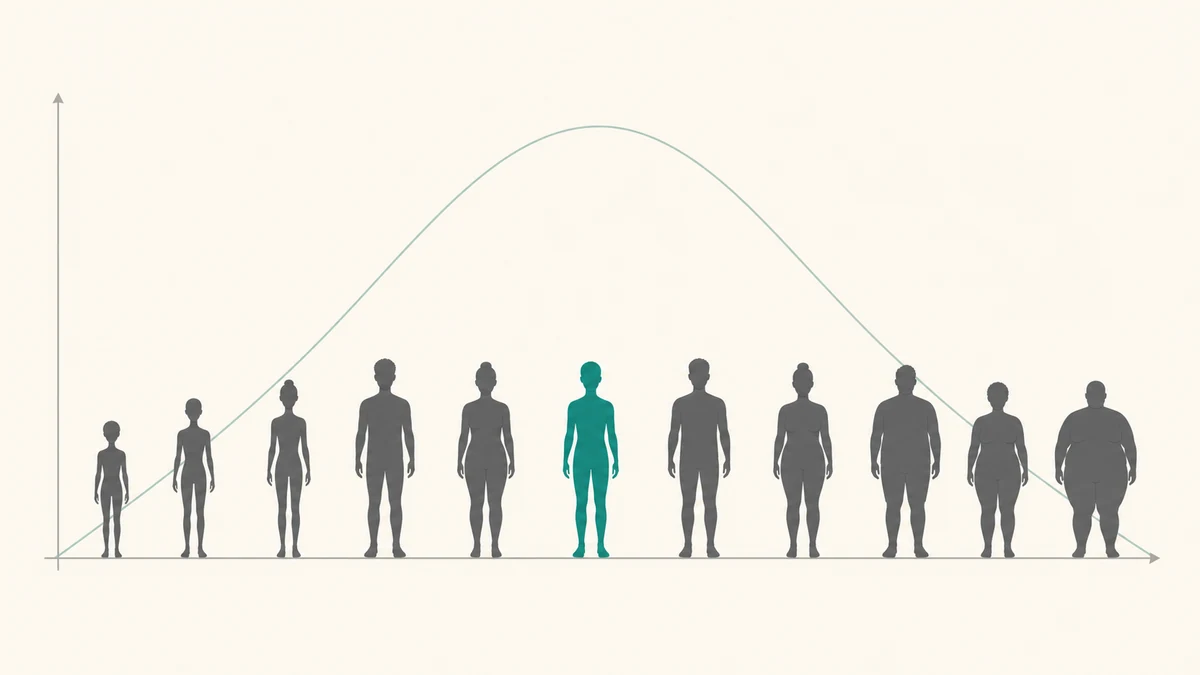
Quetelet’s project had a name: l’homme moyen, the average man. He wanted to describe the typical measurements of a population and map how individuals spread out around that center.
The index was a comparison instrument for groups — one national population against another, one generation against the next. It was a way to summarize a crowd, not to evaluate a body. Quetelet showed no interest in body fat or in what any single person’s ratio might mean for their health. That was simply not the question he was asking.
The core of the story
The tool was built to point at populations. Almost everything that has gone wrong with BMI since comes from turning it around to point at one person.
How did the Quetelet Index become “BMI”?
Skip forward to 1972. Ancel Keys — an American physiologist best known for the Seven Countries Study of heart disease — published a paper called “Indices of relative weight and obesity” in the Journal of Chronic Diseases.
Keys and his co-authors compared several competing height-and-weight formulas to see which one best tracked body fatness while staying independent of height itself. Quetelet’s weight-over-height-squared came out ahead of the alternatives. Keys gave it its modern name: the body mass index.
The data behind that paper came from men who had already been screened as healthy, drawn from population groups in more than one country. In other words, it was a study designed around groups — consistent with the way Quetelet had used the ratio in the first place. We could not open the original paper to check its sample figures, so this article does not cite them.
One more piece of context. Before Keys, the weight reference most American doctors reached for was not a scientific standard at all. It came from life insurance company tables — essentially a record of which policyholders had lived longest — first published as “ideal weights” in the 1940s. Part of what Keys’ paper argued was that medicine should replace those actuarial charts with something actually measured.
What BMI can’t see
Because BMI is built from only two numbers, it is blind to almost everything else about a body.
- It can’t separate muscle from fat. Muscle is denser than fat, so people who strength-train, and many athletes, can land in a high BMI category without carrying excess fat. Two people with the same BMI can have very different amounts of body fat.
- Sex changes the meaning. At the same BMI, women on average carry a higher percentage of body fat than men.
- Ancestry changes the meaning. The relationship between BMI and actual body fat varies by racial and ethnic group, as well as by sex and age.
- Age changes the meaning. The standard adult cutoffs may not carry the same predictive weight after roughly age 65, when muscle loss and changes in body composition are common.
This is why a single BMI reading works better as the opening of a conversation than as the end of one. If you’ve noticed your body responding differently to the same activity as you get older, that shift in muscle and composition is real — we cover it in Why Strength Feels Different After 50.
Has the medical view of BMI changed?
Yes, and recently. In June 2023 the American Medical Association adopted a policy describing BMI as an “imperfect” clinical measure and advising physicians not to use it as a standalone tool.
The AMA’s statement went further than accuracy. It acknowledged BMI’s history of harm, including its use “for racist exclusion,” and noted that the thresholds were derived largely from data on earlier generations of non-Hispanic white populations — which is part of why the same number means different things across racial and ethnic groups, sexes, and ages.
The AMA did not tell doctors to abandon BMI. It told them to pair it with other information: waist circumference, direct measures of body composition, and a person’s overall metabolic picture. The CDC likewise describes adult BMI as a screening tool, not a diagnosis of body fatness or health for any individual.
What this history means for your own number
A few things follow from all of this.
- Your BMI is a ratio, not a diagnosis. It was designed to describe groups, and it does that job reasonably well.
- It is most useful as a trend over time, or read alongside other information — a waist measurement, recent blood work, how you move and feel, your family history.
- If your number puts you in a category that worries you, treat that as a reason to talk with a clinician who can look at the whole picture — not as a result to act on by yourself.
- If you want to see the arithmetic for yourself, our BMI calculator shows your number and the standard categories with these same caveats attached. See the full BMI chart for women by height. And if you’d rather look at your body through a different lens — daily energy use instead of a weight-to-height ratio — the TDEE calculator is a separate tool for that.
The number isn’t the problem. Asking it a question it was never built to answer is.
Sources
- Gerald Eknoyan, “Adolphe Quetelet (1796–1874) — the average man and indices of obesity,” Nephrology Dialysis Transplantation, 2008. academic.oup.com
- “Origins and evolution of body mass index (BMI): continuing saga,” commentary, International Journal of Epidemiology, 2014. academic.oup.com
- Wu Y. et al., “Advantages and Limitations of the Body Mass Index (BMI) to Assess Adult Obesity,” International Journal of Environmental Research and Public Health, 2024. pmc.ncbi.nlm.nih.gov
- Keys A., Fidanza F., Karvonen M.J., Kimura N., Taylor H.L., “Indices of relative weight and obesity,” Journal of Chronic Diseases, 1972. jclinepi.com
- American Medical Association, “AMA adopts new policy clarifying role of BMI as a measure in medicine,” press release, June 2023. ama-assn.org
- Centers for Disease Control and Prevention, “About Adult BMI,” last reviewed 2024. cdc.gov
Editorial note: We could not open the full text of the 1972 Keys paper (the publisher page returned an access error), so this article does not cite any figure for its sample size, number of cohorts, or number of countries; the sample is described only in general terms. Quetelet’s work is dated to 1832 in most histories, with his major treatise Sur l’homme appearing in 1835. The AMA policy is commonly reported as adopted on June 14, 2023; we cite it here as “June 2023” pending verbatim confirmation of the date.
Medical disclaimer
Health Atlas provides educational information and does not diagnose medical conditions or replace individualized care from a qualified healthcare professional. Nothing here is medical advice about your weight, your BMI, or any change to your diet or activity.
Was this article helpful?
